In praise of problems: a useful training tool
If your immediate reaction to this headline is to run away thinking, "Oh no. I hate problems. There are pieces all over the place, and they're totally artificial... etc etc", then please bear with me for just a few minutes; for until quite recently that would have been my reaction too.
Ah, but I'm not talking about those difficult ones with an entire forest of pieces placed seemingly at random (though in actual fact they are positioned very carefully indeed). I am talking in this article about simpler ones with about half a dozen pieces, and in positions not too far off what you might encounter in a real game. All of them will be of the form "White to play and mate in two moves", so let's have a look at a few examples, but first: some ground rules.
The positions will be legal
All the positions you are presented with will be legal. They might look a bit odd, but they will be legal.
Castling will also be legal, unless you can prove otherwise. Same with en passant.
Here's a nice little example.
Castling is legal
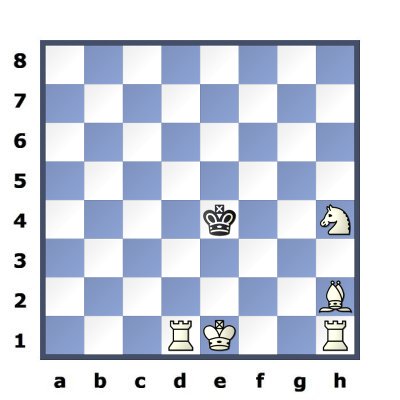
White to play and mate in two moves.
The solution is 1. 0-0.
Black can only move 1…Ke3, and he is mated by 2. Rfe1.
Some objections to problems
You will have noticed that in the previous example White is up two Rooks, a Bishop and a Knight. So what? It is not a game of chess, but a problem with a specific task, and whether one side could win easily in a real game is of no importance. White to play and mate in two moves means exactly what it says, and that is the task: mating in three moves is simply not good enough - let alone reducing to a winning ending.
I have taken a paragraph to emphasise this point, for I well know the temptation not to see the difference between chess games and chess problems. It really doesn't matter what material disparity there might be; your job (on this page anyway) is to mate in two moves.
Do problems help your chess?
Yes, I think so, for two main reasons. Take the following problem:
The scope of the Queen

In a game, I'd probably just play 1. Qa7 and force a winning King + Pawn ending; but that does not mate in two. To achieve that, the Queen has to take advantage of her board-wide mobility.
1. Qh1 is the key, and mate then comes with either 2. Qh8 or 2. Qa8, depending on Black's reply.
From h1, the Queen controls all four corners of the board.
Problems highlighting the scope of Queens are quite common, and they force to you to think of all possible moves. In a real chess game, there is a natural tendency to think mainly about the area where the action seems to be centred; problems, on the other hand, force you to be aware of the board-wide potential of long-distance pieces.
Discipline and accuracy
When you're looking at positions from actual games with the task "White to play and win" there is a temptation to spot a likely move and then to imagine you've solved it even if you can't see every variation through to the end.
This does not work in problems: you may only be looking three half-moves in front but on the other hand to need to check every single defence by Black, and confirm that all of them will allow mate on the next move. You are forced to visualise the board 100% accurately, and that can't do your game any harm.
Let's have a look at a game from 1912.
Edward Lasker v Sir George Thomas, 1912
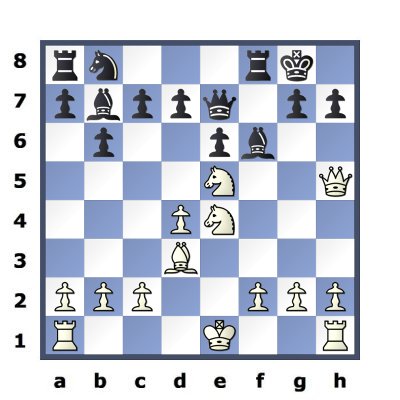
That's no good in problems. OK, you're only asked to see two moves, but you must see them with absolute precision. "2. Nf6+ and it looks like the King is in trouble" is not a solution.
Accuracy is essential
There is no room for woolliness in solving compositions. Take the example below.

The trouble is that the knight can block your ambitions: for example 1. Qd2 Nf2 2. Qh7+ is refuted by 2…Nh3. Or you might try 1. Qa1, intending 2. Qh8#. Alas, that is refuted by 1...Nb2: h8 is blocked off, and 2. Kf2+ is met by 2…Nd1.
The key is 1. Qb1, followed by either 2. Qh7# or 2. K(x)f2#. Solving it requires you to test you all the defensive moves by Black, which is the main value of these exercises.
The bottom line
Does all this help your sighting?First of all, I did hundreds of these comparatively easy problems, and I did feel I was seeing the board better after that (I was of course setting them all up on a real board. That is surely essential). Was all this reflected in my results? Probably not, but I did feel better, and in particular more at ease in tactical situations.
Notes on Ed Lasker v Thomas
The game Edward Lasker v George Thomas ended 11. Qxh7+ Kxh7 12. Nxf6+ Kh6 13. Neg4+ Kg5 14. h4+ Kf4 15. g3+ Kf3 16. Be2+ Kg2 17. Rh2+ Kg1 18. Kd2#The full game can be played through at… https://www.chessgames.com/perl/chessgame?gid=1259009
The Polgar book
All but one of the problems mentioned here come from Chess: 5334 Problems, Combinations, and Games by Laszlo Polgar.